Thursday, November 27, 2008

Giving Thanks in Difficult Times


Thanksgiving comes at a difficult time this year. Our economy is imploding. Stocks are down and anxiety is up. Citigroup, one of the largest companies in the world, lost sixty percent of its value in one week. The American auto industry is closing plant after plant. The Big Three automakers are begging Congress for a bailout. Small businesses are shutting their doors left and right, and consumer confidence is dangerously low. In this atmosphere, it is easy to despair or bemoan our state, but, during this one day of the year specifically centered on giving thanks, we should take the opportunity to gain perspective on the important things in life and to be thankful for what we have.

Many Americans have lost their homes or their jobs. Many others are struggling to afford gas or groceries. These times are not easy for anyone, but we should not despair. Our lives are not defined by how much we own or where we live. Our worth is not dependent on our material possessions. Our relationship to God and to our fellow man is what really defines us. God, family, and community always remain, despite our financial difficulties. These are the things for which we should give thanks.

There is a temptation to worry obsessively about our financial plight. But this temptation betrays too great a reliance on self. God knows our needs and He cares for us. The Gospel of Luke assures us that God cares for the birds of the air, the lilies, and the grass of the field and that we are more valuable to Him than they (Luke 12). He assures us that he will provide for us if we will but seek his kingdom. In good times and bad, he exhorts us to place our confidence not in ourselves but in him. We, of course, have a duty to make wise, careful decisions, but we will not add "a single hour" to our lives by worrying. (Luke 12:25 NIV) We have better things to do with our energy. Worry helps no one and harms our souls.

It is hard to imagine now, but this economic downturn may ultimately be a boon to our society. Perhaps we will relearn the virtues of saving more than we spend, of denying ourselves material wants we can't afford, of spending more time with family, community, and church. For years, maybe decades, our holidays have been dominated by consumerism—epitomized by the "Black Friday" shopping extravaganza after Thanksgiving. Faith, family, and friends were often lost in the hustle and bustle of decorating, shopping, and holiday planning. Our goals and sense of worth are too often centered on material gain: we want to retire by 65, we want to buy a vacation house, we want to get a new TV, etc. We spend so much time trying to achieve these ends that we miss out on the more important things in life.

We are tempted to worry as our mutual funds and retirement accounts dwindle. Many people approaching retirement age are watching their savings disappear before their eyes. They will have to work many years longer than they originally planned in order to stay afloat. This is an incredibly difficult time for those who place all of their hopes in their retirement, waiting until 65 to "really live." But for those who keep life in perspective, the draining of retirement accounts and the shrinking of mutual funds is difficult but not debilitating. This crisis presents us with a choice: either focus on the difficult times and spend the next several years worried and depressed, or work hard, tighten our belts, and find joy in the truly important things in life.

The Apostle Paul instructs us, "Be joyful always; pray continually; give thanks in all circumstances, for this is God's will for you in Christ Jesus." (1 Thess. 5:16-18 NIV) This admonition came from a man who suffered far more difficulties than most of us will likely ever face. A man of great influence who was held in high esteem, he was brought low and suffered persecution and imprisonment for his faith in Christ. Paul was a man who knew what it was to be in need and to have plenty; nevertheless, he declared that he had "learned the secret of being content in any and every situation, whether well fed or hungry, whether living in plenty or in want." (Phil. 4:12 NIV) His secret? "I can do everything through him who gives me strength." (Phil. 4:13 NIV)

Paul's secret can be our secret, too. Recognizing God's providence and his care for us will enable us to give thanks, even in difficult times.

Ken Connor, Copyright © 2008 Salem Web Network. All Rights Reserved.

A New Thing


When God calls you into a new endeavor you will find that God will anoint you in areas you considered your weakest traits. God turns shepherds like Moses into leaders of nations. He turns farmers like Gideon into reformers. He turns impetuous and unstable personalities like Peter into leaders that can transform a culture and lead a movement.

Whenever God does a new thing in a life, those who knew them before notice the change. Quiet people become bold. Poor speakers learn to become great communicators. Those who were never leaders before become the new leaders. This is the way of God.

When God looks at an individual, He looks at their future, not their past. He is always looking at the person He has created you to become, not the person you are now. When Samuel anointed the young shepherd boy, David, to be the next king of Israel, it would be years before this would happen. However, God already knew who he was to become.

How does God view your life? What is the destiny He has chosen you to fulfill?

Wednesday, November 19, 2008

Consider This

Too many people expect God to work through them when they don't even let Him work in them.

Tuesday, November 18, 2008

The Power of Focus


"No stream or gas drives anything until it is confined. No Niagara is ever turned into light and power until it is tunneled. No life ever grows great until it is focused, dedicated and disciplined." - Harry E. Fosdick

Monday, November 17, 2008

Obedience = Safety


To be entirely safe from the devil's snares the man of God must be completely obedient to the Word of the Lord. The driver on the highway is safe, not when he reads the signs but when he obeys them. - A.W. Tozer

Tuesday, November 11, 2008

Thanksgiving Dinner Outreach

PLEASE NOTE: If you are preparing food, do not use pork (i.e., ham, bacon, etc.) in anything you cook. Thanks.

Our connection class will be hosting a Thanksgiving dinner the evening of Nov. 15 in the fellowship
hall. Our invited guests are approximately 10-15 Iraqi families. Michael will speak about the history and meaning of Thanksgiving and the class will offer tips and training on various basic life skills that may be new or unfamiliar to the Iraqi families. We plan to take the youngsters to the Refuge to watch part of the HPCA Cougar basketball tournament.

If you can speak Arabic, or if you have a heart for people, or you just want to help, please contact Hap O'Hair at 669-4743 or by email at hapohair@crescentford.com.

Monday, November 10, 2008

Thanksgiving's Origins

The Pilgrims left Plymouth, England, on September 6, 1620. Their destination? The New World. Although filled with uncertainty and peril, it offered both civil and religious liberty.

For over two months, the 102 passengers braved the harsh elements of a vast storm-tossed sea. Finally, with firm purpose and a reliance on Divine Providence, the cry of "Land!" was heard.

Arriving in Massachusetts in late November, the Pilgrims sought a suitable landing place. On December 11, just before disembarking at Plymouth Rock, they signed the "Mayflower Compact" - America's first document of civil government and the first to introduce self-government.

Pumpkins. Photo copyrighted. After a prayer service, the Pilgrims began building hasty shelters. However, unprepared for the starvation and sickness of a harsh New England winter, nearly half died before spring. Yet, persevering in prayer, and assisted by helpful Indians, they reaped a bountiful harvest the following summer.
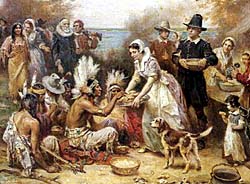
The grateful Pilgrims then declared a three-day feast, starting on December 13, 1621, to thank God and to celebrate with their Indian friends. While this was not the first Thanksgiving in America (thanksgiving services were held in Virginia as early as 1607), it was America's first Thanksgiving Festival.

Artist's depiction of the first Thanksgiving. Courtesy of Eden Communications. Pilgrim Edward Winslow described the Pilgrims' Thanksgiving in these words:
"Our harvest being gotten in, our Governor sent four men on fowling [bird hunting] so that we might, after a special manner, rejoice together after we had gathered the fruit of our labors. They four in one day killed as much fowl as... served the company almost a week... Many of the Indians [came] amongst us and... their greatest King, Massasoit, with some ninety men, whom for three days we entertained and feasted; and they went out and killed five deer, which they brought... And although it be not always so plentiful as it was at this time with us, yet BY THE GOODNESS OF GOD WE ARE... FAR FROM WANT."

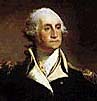
George Washington, first President of the United States. Photo courtesy of Eden Communications. In 1789, following a proclamation issued by President George Washington, America celebrated its first Day of Thanksgiving to God under its new constitution. That same year, the Protestant Episcopal Church, of which President Washington was a member, announced that the first Thursday in November would become its regular day for giving thanks, "unless another day be appointed by the civil authorities." Yet, despite these early national proclamations, official Thanksgiving observances usually occurred only at the State level.

Much of the credit for the adoption of a later ANNUAL national Thanksgiving Day may be attributed to Mrs. Sarah Joseph Hale, the editor of Godey's Lady's Book. For thirty years, she promoted the idea of a national Thanksgiving Day, contacting President after President until President Abraham Lincoln responded in 1863 by setting aside the last Thursday of November as a national Day of Thanksgiving. Over the next seventy-five years, Presidents followed Lincoln's precedent, annually declaring a national Thanksgiving Day. Then, in 1941, Congress permanently established the fourth Thursday of each November as a national holiday.

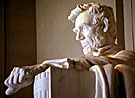
Abraham Lincoln statute, Lincoln Memorial, Washington, D.C. Photo courtesy of Wallbuilders. Lincoln's original 1863 Thanksgiving Proclamation came - spiritually speaking - at a pivotal point in his life. During the first week of July of that year, the Battle of Gettysburg occurred, resulting in the loss of some 60,000 American lives. Four months later in November, Lincoln delivered his famous "Gettsysburg Address." It was while Lincoln was walking among the thousands of graves there at Gettysburg that he committed his life to Christ. As he explained to a friend:

When I left Springfield [to assume the Presidency] I asked the people to pray for me. I was not a Christian. When I buried my son, the severest trial of my life, I was not a Christian. But when I went to Gettysburg and saw the graves of thousands of our soldiers, I then and there consecrated myself to Christ.

As Americans celebrate Thanksgiving each year, we hope they will retain the original gratefulness to God displayed by the Pilgrims and many other founding fathers , and remember that it is to those early and courageous Pilgrims that they owe not only the traditional Thanksgiving holiday but also the concepts of self-government, the "hard-work" ethic, self-reliant communities, and devout religious faith.

Saturday, November 8, 2008

I'm not ready!

"But he said to me, 'My grace is sufficient for you, for my power is made perfect in weakness'" (2 Cor 12:9).

If there is one thing that is consistent throughout scripture, it is this: God calls people when they are not ready. God will never call you into service when you think you are ready. This is intentional on God's part.

And, you can be sure when God calls you, you will have similar responses as Saul did when he was called to be the first king, or Gideon, when he was called to take down the idols in his nation, or Moses, when he was called to deliver his people from Egypt.

Saul answered, "But am I not a Benjamite, from the smallest tribe of Israel, and is not my clan the least of all the clans of the tribe of Benjamin? Why do you say such a thing to me?" (1 Sam 9:21).

"But Lord," Gideon asked, "how can I save Israel? My clan is the weakest in Manasseh, and I am the least in my family" (Judg 6:15).

But Moses said to God, "Who am I, that I should go to Pharaoh and bring the Israelites out of Egypt?" (Ex 3:11).

When God calls, you will most likely be in the most unlikely circumstances to receive that call. You will be in the midst of a crisis, you will lack resources, you will not have the skills you think you need. This too is the way of God.

God does this because He wants you to know your call is only based on His ability, not yours. When you think it is based on you, this is a false humility. And, it is unbelief and disobedience on your part.

Has God called you to something you have failed to do because you felt you were not ready? Repent before the Lord and let God accomplish great things through you.